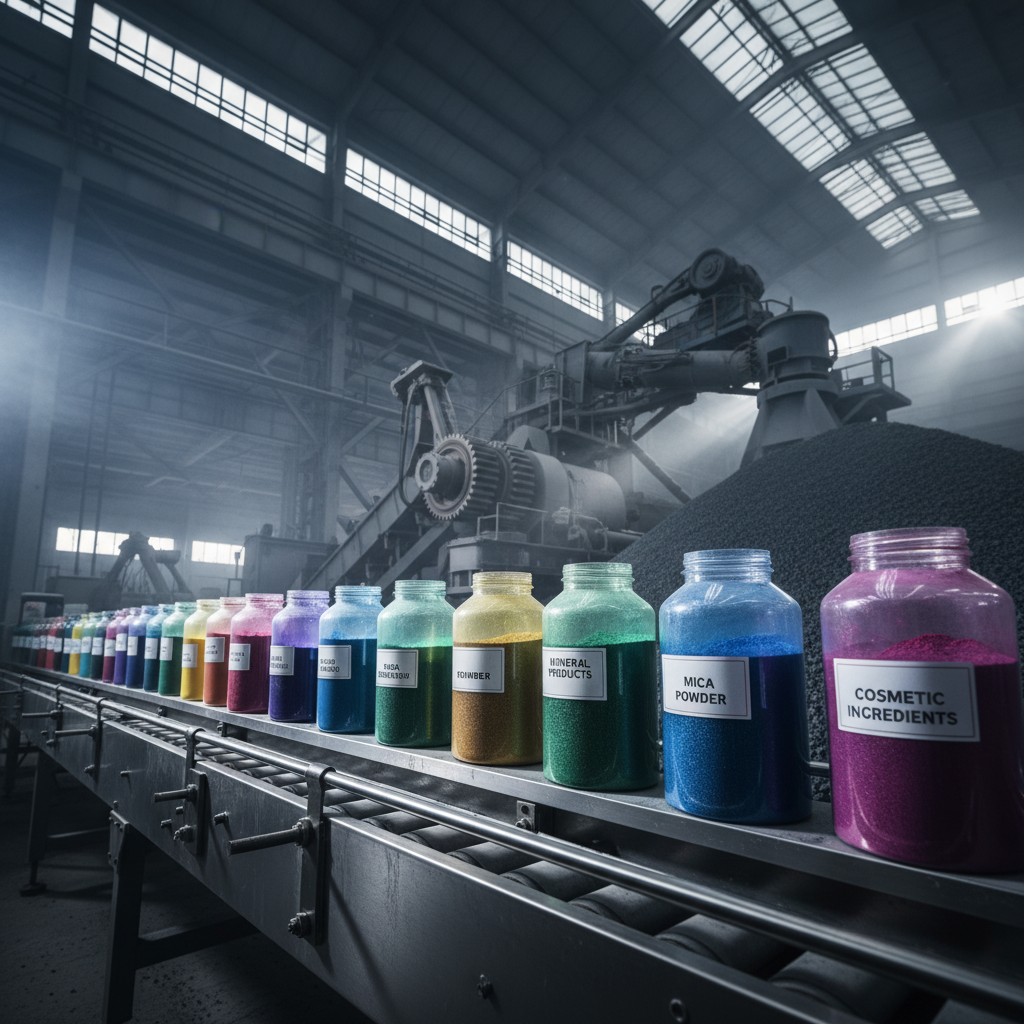
Achieving the perfect "shimmer" or "glow" in cosmetic formulations is rarely about the pigment alone; it is fundamentally about the substrate's structural precision. In the high-end cosmetics market, the difference between a coarse glitter and a sophisticated pearlescent finish lies in the particle size distribution of the mica.
For manufacturers, sourcing wholesale mica powder for cosmetics involves balancing chemical purity with physical morphology. As regulatory scrutiny over mineral sourcing and safety increases, the industry is shifting toward synthetic and highly refined natural micas that offer predictable results and strict compliance with REACH and ROHS standards.
This technical observation explores the critical parameters of mica processing—from wet hydraulic grinding to the importance of the diameter-thickness ratio—and how these factors directly influence the optical performance of the final cosmetic product.


In the context of pearlescent pigments, mica acts as the carrier. Any "mud" or debris attached to the mica sheet, or incomplete crystallization between the interlayers, acts as a light-absorbing contaminant. This reduces the overall whiteness and the "flicker" effect of the final pigment.
To combat this, advanced processing involves repeated cleaning cycles. By removing surface debris and optimizing the interlayer space, manufacturers can ensure a bright, clear substrate. For professional-grade cosmetic mica, whiteness levels exceeding 95ppm are often the baseline to ensure that the subsequent titanium plating is uniform and saturated.
The method of size reduction is as critical as the material itself. Traditional dry grinding often results in shattered mica sheets and irregular edges, which scatter light inconsistently. To maintain the integrity of the mica's plate-like structure, pure wet hydraulic grinding is employed. This method minimizes equipment-induced scratches on the mica surface.
Strong shear forces are applied during this process to maintain a high diameter-to-thickness ratio. When the mica sheets remain wide but thin, they act as more efficient mirrors for light reflection, which is the fundamental mechanism behind the "shimmer" seen in high-end eyeshadows and highlighters.
Huajing leverages this specialized grinding technology, drawing on three decades of experience in the Lingshou mica base, to produce synthetic mica with extremely fine dimensions—down to D50 values of 5-7μm—ensuring the smallest possible particle size without sacrificing structural stability.
A common failure in low-grade mica powder is a wide particle size distribution, where very large and very small particles coexist. This leads to an uneven application of titanium plating, resulting in "spots" of varying intensity rather than a smooth, saturated glow.
Narrow particle size distribution is the primary driver of uniformity in pearlescent pigments; it ensures that every mica plate reflects light at the same angle and intensity, maximizing the saturation of the plating.
By controlling the D10 (2-4μm) and D90 (12-15μm) ranges strictly, manufacturers can guarantee that the pigment behaves predictably across different cosmetic bases, whether in a cream, powder, or liquid formulation.
When evaluating wholesale mica powder for cosmetics, buyers should look beyond simple whiteness. The "Flicker Index" and "Saturation Uniformity" are more indicative of how the product will perform under different lighting conditions.
A high-performance mica powder allows for a "small addition, high flicker" result, meaning the formulator can use less material to achieve a more intense visual effect, thereby reducing the risk of the product feeling "gritty" on the skin.
In a typical industrial setting, a cosmetics manufacturer creating a luxury highlighter will require a mica powder with a very narrow D50 range. If the powder is too coarse, the highlighter will look like glitter; if it is too fine, the luminosity is lost. The use of synthetic mica with a D50 of 5-7μm provides that elusive "lit-from-within" glow that is currently trending in the global market.
Beyond luxury cosmetics, this level of purity is essential for nail polishes and liquid foundations, where particles must be small enough to avoid clogging application nozzles while remaining large enough to provide a visible pearlescent effect.
The cosmetic industry is facing an urgent transition toward "green" and ethical mineral sourcing. The move toward synthetic mica is not just about technical performance, but about ensuring a supply chain free from unethical mining practices. Synthetic versions allow for total control over purity and a reduced environmental footprint.
Moreover, the integration of ISO14001:2015 and ISO45001:2018 certifications in the production process reflects a broader industry shift toward sustainable factory concepts. Reducing water waste during the wet grinding process and implementing closed-loop filtration systems are becoming standard requirements for global suppliers.
As brands market "Clean Beauty," the demand for mica that is not only REACH compliant but also produced in "Green Factories" is growing. This ensures that the non-renewable nature of mineral resources is managed with maximum efficiency and minimal waste.
Procuring mica in bulk requires a rigorous evaluation of the Technical Data Sheet (TDS) and Material Safety Data Sheet (MSDS). Buyers often make the mistake of focusing solely on the average particle size, neglecting the D10 and D90 values which reveal the actual distribution width.
Another critical trade-off is between price and whiteness. While lower-grade micas are available, the cost of repeated cleaning and high-precision grinding is offset by the reduced amount of pigment needed in the final formulation to achieve the desired effect.
The following framework provides a comparative look at how different grades of mica powder suit various cosmetic application requirements.
| Mica Grade | Particle Size Range | Primary Optical Effect | Ideal Application |
|---|---|---|---|
| Industrial Grade | Wide (>20μm) | Coarse Glitter | Basic Body Glitters |
| Refined Natural | Medium (10-20μm) | Soft Shimmer | Daily Face Powders |
| High-Purity Synthetic | Narrow (5-15μm) | Saturated Pearl | Luxury Highlighters |
| Ultra-Fine Synthetic | Very Narrow (2-7μm) | Smooth Glow | Liquid Foundations |
| Specialty Plated | Customized | Multi-chrome / Metallic | Professional Art Makeup |
| Huajing Premium | D50: 5-7μm | High Flicker/Pure White | High-End Pearlescent Pigments |
Synthetic mica offers unmatched purity and a more consistent particle size distribution. Natural mica can contain impurities like iron oxides or organic debris, which can dull the final color. Synthetic versions are engineered to have extremely high whiteness (>95ppm) and a uniform plate structure, which is essential for the high-saturation flicker effect required in luxury pearlescent pigments.
The D50 value represents the median particle size. In cosmetics, a D50 that is too high (coarse) can lead to a "gritty" or "sandy" texture on the skin, which is undesirable for face products. A D50 in the 5-7μm range, combined with a narrow distribution, ensures the powder feels smooth and blends seamlessly into the skin while still providing significant optical reflection.
Dry grinding uses impact and attrition, which often shatters the mica's natural plate structure into irregular fragments. Wet hydraulic grinding uses fluid dynamics and controlled shear forces. This preserves the large diameter-to-thickness ratio of the mica sheets, ensuring they function as efficient mirrors for light, which is critical for achieving a professional pearlescent finish.
At a minimum, suppliers should provide TDS (Technical Data Sheets) and MSDS (Material Safety Data Sheets). For global compliance, ensure the product meets REACH and ROHS regulations. From a management perspective, ISO9001 (Quality), ISO14001 (Environmental), and ISO45001 (Health and Safety) certifications indicate a stable production environment and a commitment to sustainable, ethical manufacturing.
Yes, indirectly. Because a narrow distribution increases the efficiency of the titanium plating process and improves the "flicker" per gram of material, formulators can often achieve the desired visual effect using a smaller total amount of mica. This "small addition, high flicker" property reduces the overall raw material cost in the final cosmetic formulation.
Mica whiteness acts as the "canvas" for the pigment. If the mica is off-white or greyish, it will mute the brightness of the coated metal oxides (like titanium dioxide). High whiteness (>95ppm) ensures that the light reflecting back to the viewer is not filtered through impurities, resulting in a brighter, more vivid, and more saturated pearlescent color.
The transition from raw mineral to a high-performance cosmetic ingredient is a journey of extreme precision. The ability to control particle size distribution, maintain a high diameter-thickness ratio, and ensure absolute chemical purity is what separates industrial-grade minerals from professional cosmetic substrates.
As the beauty industry moves toward more sustainable and transparent supply chains, the reliance on precision-engineered synthetic mica will only grow. By focusing on the technical fundamentals of grinding and purity, manufacturers can create products that meet both the aesthetic demands of consumers and the rigorous safety standards of global regulators.