The global market for mica, a naturally occurring mineral prized for its unique properties, is experiencing fluctuating prices driven by supply chain dynamics, geopolitical factors, and growing demand across diverse industries. Understanding the intricacies of mica price is crucial for businesses involved in cosmetics, paints, electronics, and automotive manufacturing, as it directly impacts production costs and profitability. A stable and predictable mica price also affects ethical sourcing initiatives, particularly concerning child labor in mica mining regions.
Globally, the mica industry is valued at billions of dollars, with India and China being major producers and consumers. Recent disruptions in supply chains due to the pandemic and geopolitical instability have led to significant price volatility, raising concerns about market access and fair trade practices. The responsible sourcing of mica is increasingly vital, with companies actively seeking ways to ensure ethical and sustainable practices throughout the supply chain, ultimately influencing mica price points.
Fluctuations in mica price are not just a concern for manufacturers; they have social implications for the communities involved in mica mining. Addressing these challenges requires a collaborative approach involving governments, industry stakeholders, and NGOs to promote responsible mining practices, support local economies, and ensure fair compensation for workers.
The Significance of mica price in Global Trade
Mica's role in global trade extends far beyond its relatively low individual unit cost. As a critical component in numerous industries, changes in mica price ripple through supply chains, affecting finished goods costs and overall economic activity. The geographical concentration of mica production, particularly in developing nations, adds another layer of complexity, requiring careful consideration of ethical sourcing and sustainable practices.
The transparency of mica price discovery is also becoming increasingly important. Historically, the mica trade has been characterized by opacity, making it difficult to track origin and ensure fair pricing. Efforts to improve traceability and establish clear price benchmarks are gaining momentum, driven by consumer demand for ethical products and regulatory scrutiny.
Defining mica price: A Comprehensive Overview
Mica price, in its simplest form, represents the monetary value assigned to a unit of mica, typically measured in metric tons or kilograms. However, this seemingly straightforward definition belies a complex pricing structure influenced by various factors including grade, particle size, color, and the presence of impurities. Different grades of mica (muscovite, phlogopite, vermiculite) command different prices reflecting their varying applications and performance characteristics.
Understanding the connection between mica price and modern industry is essential. Mica's excellent dielectric properties make it indispensable in the electronics industry, particularly in capacitors. In cosmetics, it provides shimmer and opacity. In paints and coatings, it enhances durability and weather resistance. These diverse applications create a robust demand base that directly impacts pricing.
Furthermore, the ethical considerations surrounding mica sourcing are increasingly influencing perceived value and, consequently, mica price. Consumers are willing to pay a premium for mica sourced from responsible suppliers who adhere to fair labor practices and environmental standards, a trend that is reshaping the industry landscape.
Core Factors Influencing mica price Dynamics
Several core factors drive fluctuations in mica price. Geological availability is a fundamental determinant – the scarcity of high-quality mica deposits in certain regions naturally impacts costs. Labor costs in mining regions, particularly in areas where manual labor is prevalent, also play a significant role.
Transportation costs are another crucial element. Mica is often mined in remote locations, necessitating significant expenses for transportation to processing facilities and ultimately to end-users. Political stability within mining regions is also paramount, as disruptions due to conflict or regulatory changes can severely impact supply and drive up mica price.
Finally, global economic conditions exert considerable influence. Strong economic growth typically leads to increased demand across all industries, including those that rely on mica, pushing prices upward. Conversely, economic downturns can dampen demand and result in price reductions.
Global Applications and the Impact on mica price
Mica finds extensive application in a wide range of industries globally, each with unique demands influencing mica price. The electronics sector remains a dominant consumer, utilizing mica in capacitors, insulators, and other critical components. The automotive industry utilizes mica in paints and coatings for enhanced durability and aesthetics.
In the cosmetics industry, mica provides a shimmering effect in makeup products, contributing significantly to demand. Paint manufacturers incorporate mica to improve paint coverage, durability, and resistance to weathering. In post-disaster relief operations, mica sheets can be used for emergency shelters, showcasing its versatility.
Comparison of mica price based on Application
Advantages of Stable mica price and Long-Term Value
A stable mica price offers significant advantages to businesses, enabling accurate budgeting and forecasting. It fosters long-term planning and investment, reducing the risks associated with volatile commodity markets. Predictable costs enhance competitiveness and profitability, ultimately benefiting consumers.
Beyond economic benefits, responsible mica sourcing and price stability contribute to social and environmental sustainability. Supporting ethical mining practices ensures fair labor conditions and protects vulnerable communities. A commitment to sustainable sourcing builds trust with consumers and enhances brand reputation.
Future Trends Shaping the mica price Landscape
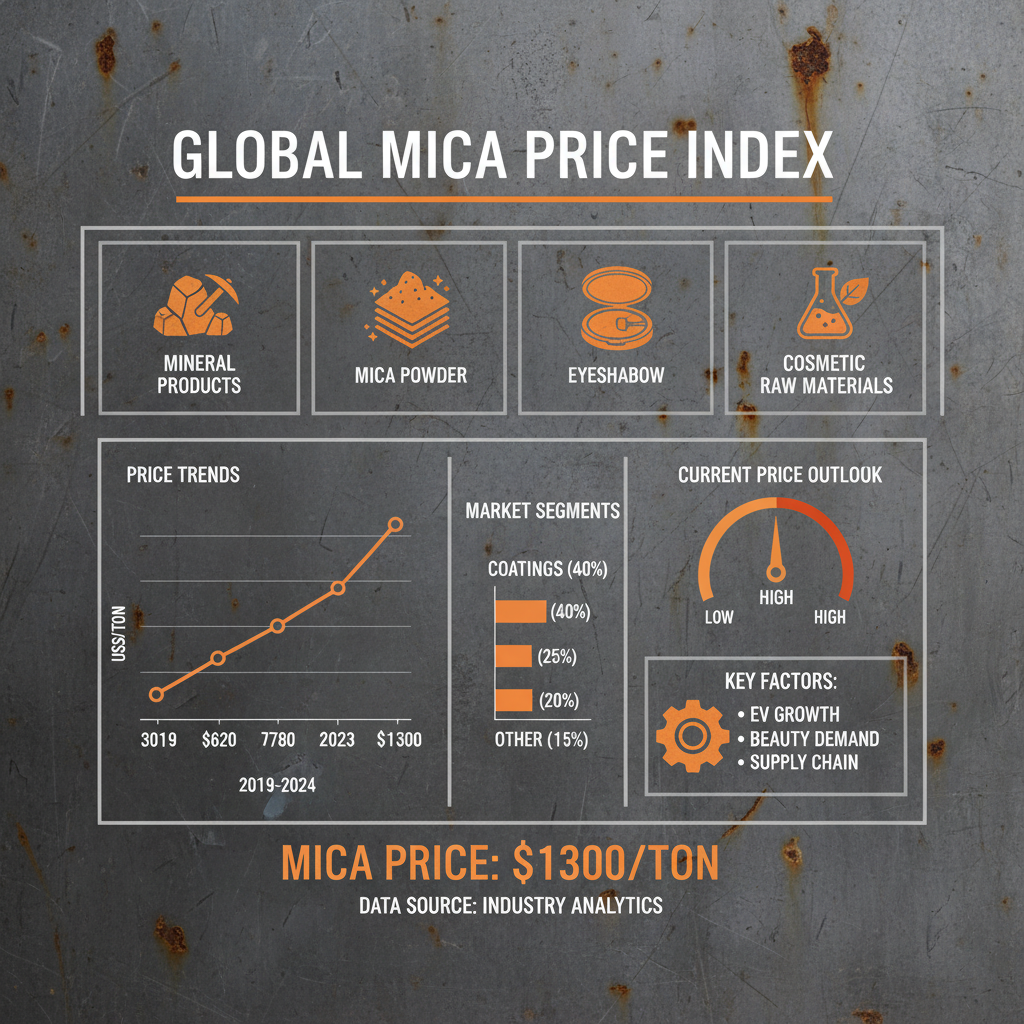
The future of mica price will be shaped by several emerging trends. Increased demand for electric vehicles (EVs) is expected to drive up demand for mica used in battery components. Advances in nanotechnology may lead to new applications for mica, further boosting demand.
The growing emphasis on circular economy principles will likely influence mica sourcing and recycling practices. Companies will increasingly prioritize sustainable alternatives and explore ways to recover mica from end-of-life products.
Digital technologies, such as blockchain, are being explored to enhance transparency and traceability in the mica supply chain, potentially leading to more stable and ethical pricing mechanisms.
Challenges and Solutions in mica price Management
Despite the benefits of stability, managing mica price presents ongoing challenges. The opacity of the supply chain makes it difficult to assess true production costs and identify potential ethical concerns. Geopolitical risks and supply chain disruptions can lead to sudden price spikes.
Solutions include investing in supply chain transparency initiatives, diversifying sourcing locations, and promoting responsible mining practices. Collaboration between industry stakeholders, governments, and NGOs is crucial to address systemic challenges.
Developing alternative materials with similar properties to mica could also mitigate price volatility and reduce dependence on specific suppliers.
Summary of Key Challenges & Mitigation Strategies for Mica Price Volatility
| Challenge |
Impact on mica price |
Mitigation Strategy |
Implementation Priority (1-5) |
| Supply Chain Opacity |
Difficulty in assessing true costs and ethical concerns |
Implement blockchain-based traceability systems |
4 |
| Geopolitical Instability |
Disruptions in supply and price spikes |
Diversify sourcing regions |
5 |
| Ethical Sourcing Concerns |
Reputational risk and potential price premiums |
Support fair labor practices and sustainable mining |
5 |
| Limited Supplier Base |
Reduced bargaining power and price vulnerability |
Encourage new entrants and support small-scale miners |
3 |
| Fluctuating Transportation Costs |
Increased overall mica price |
Optimize logistics and explore regional sourcing |
3 |
| Demand Surges (e.g., EV sector) |
Potential supply shortages and price increases |
Invest in research and development of alternative materials |
2 |
FAQS
Several key factors contribute to mica price volatility, including geological availability, labor costs in mining regions, transportation expenses, political stability, and broader economic conditions. Shifts in supply and demand, particularly from key industries like electronics and cosmetics, also play a significant role. Understanding these drivers is crucial for anticipating future price trends and managing procurement strategies effectively.
Ethical sourcing, which prioritizes fair labor practices and environmental responsibility, often leads to a slightly higher mica price. This premium reflects the additional costs associated with ensuring responsible mining operations and supporting local communities. However, many consumers are now willing to pay more for ethically sourced products, creating a growing market for suppliers who adhere to these standards.
Different grades of mica, such as muscovite, phlogopite, and vermiculite, have varying properties and applications, resulting in distinct price points. Muscovite, known for its high dielectric strength, typically commands a higher price than phlogopite. Particle size, purity, and color also influence the price, with finer, purer, and more vibrant mica fetching a premium.
Businesses can mitigate mica price risk through several strategies, including diversifying their sourcing locations, establishing long-term contracts with suppliers, and implementing hedging mechanisms. Investing in supply chain transparency and exploring alternative materials can also help reduce vulnerability to price fluctuations.
The growing demand for electric vehicles (EVs) is expected to significantly impact mica price. Mica is a critical component in EV battery separators, and as EV production increases, so will the demand for mica. This surge in demand could lead to supply shortages and potentially drive up prices, making it crucial for manufacturers to secure stable supply chains.
While there aren't direct substitutes for all of mica’s properties, some materials can offer comparable functionality. These include certain types of talc, calcium carbonate, and synthetic polymers. However, these alternatives often come with their own set of trade-offs in terms of performance, cost, and environmental impact. Often, the price of these alternatives can be higher, but depend on the application.
Conclusion
In conclusion, understanding mica price dynamics is paramount for businesses operating in diverse industries. From electronics and automotive to cosmetics and construction, the cost and availability of mica have significant implications for production, profitability, and sustainability. Successfully navigating the complexities of the mica market requires a proactive approach encompassing supply chain transparency, ethical sourcing, and strategic risk management.
Looking ahead, the future of mica price will be shaped by emerging trends such as the growing demand for electric vehicles, advancements in nanotechnology, and an increasing emphasis on circular economy principles. Staying informed about these developments and proactively adapting to changing market conditions will be essential for long-term success. For reliable sourcing and competitive pricing, visit our website: www.hjmica.com.